



- Product Name
- CasNo
- MF
- MW
- Content
- Appearance
- Packing
- Apply
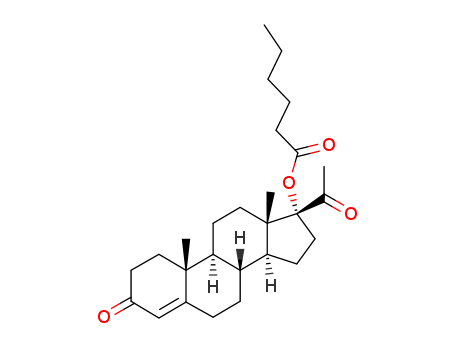
- 17a-Hydroxyprogesterone caproate
- 630-56-8
- C<sub>27</sub>H<sub>40</sub>O<sub>4</sub>
- 428.612
- White or almost White Crystalline power

Your Location:Home > Products > API > 17a-Hydroxyprogesterone caproate
|
Manufacturing Process |
40 grams of 17α-oxypregnene-(5)-ol-(3)-one-(20)-acetate-(3) is brought to reaction with 22 grams of p-toluolsulfonic acid and 850 cc of caproic acid anhydride under a nitrogen atmosphere for 5 days at room temperature or 2,5 days at 37°C. The excess anhydride is blown off with steam in the presence of 200 cc of pyridine and the distillation residue is extracted with ether and worked up as usual. The remaining oil is brought to crystallization with pentane and the raw 17α-oxypregnenolone-3-acetate-17-caproate is recrystallized from methanol. The crystals are needle-like and have a MP of 104° to 105°C. This substance is partially saponified by refluxing for 1 hour in 1,800 cc of methanol in the presence of 13 cc of concentrated hydrochloric acid. After evaporation of the methanol under vacuum, the dry residue is recrystallized from isopropyl ether or methanol (dense needles). The thus obtained 17α-oxypregnenolone-17-caproate melts at 145° to 146.5°C. By oxidation in 100 cc of absolute toluol with 425 cc of cyclohexanone and 155 cc of a 20% aluminum isopropylate solution in absolute toluol and after repeated crystallizations from isopropyl ether or methanol, 24 grams of pure 17α-oxyprogesterone-17-caproate is obtained, MP 119° to 121°C (dense needles). |
|
Therapeutic Function |
Progestin |
|
Mechanism of action |
Hydroxyprogesterone caproate is a synthetic progestin. Hydroxyprogesterone is a potent, long-acting, progestational steroid ester which transforms proliferative endothelium into secretory endothelium, induces mammary gland duct development, and inhibits the production and/or release of gonadotropic hormone; it also shows slight estrogenic, androgenic, or corticoid effects as well, but should not be relied upon for these effects. It's mechanism for preventing preterm birth in women with a history of preterm delivery is unknown. |
|
Safety |
Originally marketed (Delalutin) nearly 50 years ago to prevent impending miscarriages, 17α-hydroxyprogesterone caproate was removed from the market in 2000 when its efficacy was called into question. 17α-Hydroxyprogesterone caproate, a synthetic injectable progesterone, was approved by the FDA in 2011 to reduce the risk of preterm delivery in women who have already experienced a preterm birth.It has not been shown to be effective in women carrying multiple fetuses.Injections begin between 16 and 21 weeks and are associated with pain, swelling, or itching at the injection site, hives, nausea, and diarrhea. Follow-up studies of the children born to women who used this drug indicate that developmental milestones were achieved at 2.5 and 5 years of age. A number of other pharmacologic agents are currently available for the prevention of preterm delivery including agents that can alter intracellular messengers (e.g., β-adrenergic receptor agonists, nitric oxide donors, magnesium sulfate and calcium channel blockers) and agents that modulate myometrial stimulants (e.g., inhibitors of prostaglandin synthesis and oxytocin antagonists). 17α-Hydroxyprogesterone caproate binds extensively to albumin and SHBG. From a metabolic perspective, it undergoes reduction, hydroxylation, and conjuga- tion reactions, including becoming glucuronidated, sulfated, and acetylated. It induces several cytochrome P450 (CYP) isozymes including CYP1A2, CYP2A6, and CYP2B6. |
|
General Description |
Hydroxyprogesteronecaproate, 17-hydroxypregn-4-ene-3,20-dionehexanoate, is much more active and longer acting than progesterone, probably because the 17αester hinders reduction to the 20-ol. In contrast, hydroxyprogesteroneitself lacks progestational activity. Thecaproate ester is given only intramuscularly. The estergreatly increases oil solubility, allowing it to be slowly releasedfrom depot preparations. Although only currently available throughcompounding pharmacies, a new formulation (Gestiva) wasdeemed approvable by the FDA in late 2006 for the preventionof preterm labor, pending further studies. |
InChI:InChI=1/C27H40O4/c1-5-6-7-8-24(30)31-27(18(2)28)16-13-23-21-10-9-19-17-20(29)11-14-25(19,3)22(21)12-15-26(23,27)4/h17,21-23H,5-16H2,1-4H3/t21?,22?,23?,25-,26-,27-/m0/s1
The invention discloses a novel method f...
The invention discloses a preparation pr...
The invention discloses a synthesis meth...
A novel pharmaceutical composition for t...
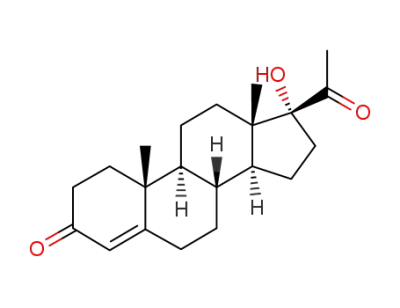
17-hydroxyprogesterone

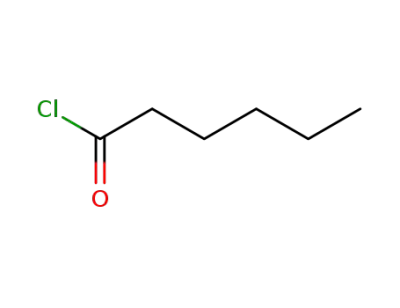
Hexanoyl chloride

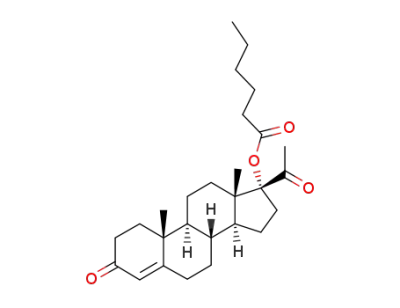
17-hexanoyloxy-pregn-4-ene-3,20-dione
| Conditions | Yield |
|---|---|
|
In
chloroform;
at 8 - 40 ℃;
for 5h;
Temperature;
|
91.4% |
17-hydroxyprogesterone
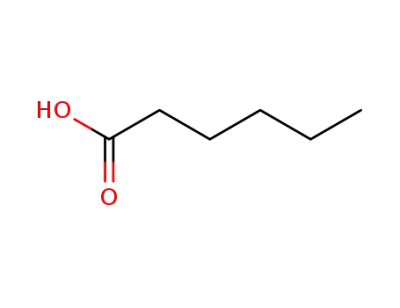
hexanoic acid
17-hexanoyloxy-pregn-4-ene-3,20-dione
| Conditions | Yield |
|---|---|
|
With
trifluoroacetic anhydride;
|
|
|
17-hydroxyprogesterone; hexanoic acid;
With
pyridine; toluene-4-sulfonic acid;
In
toluene;
at 110 - 120 ℃;
for 3h;
With
hydrogenchloride;
In
ethanol; water;
for 2h;
Reagent/catalyst;
Solvent;
Reflux;
|
19.8 g |
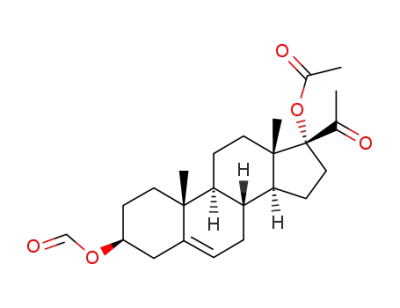
17-acetoxy-3β-formyloxy-pregn-5-en-20-one
17-hydroxyprogesterone
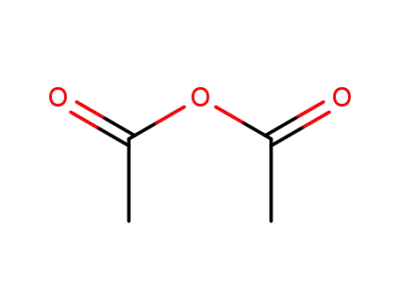
acetic anhydride
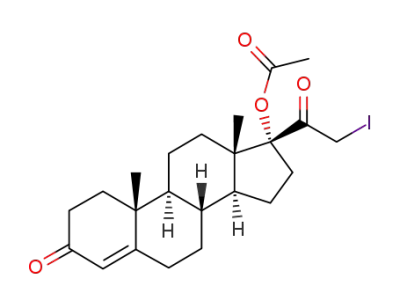
21-iodo-17α-hydroxypregn-4-ene-3,20-dione 17-acetate
17-hydroxyprogesterone
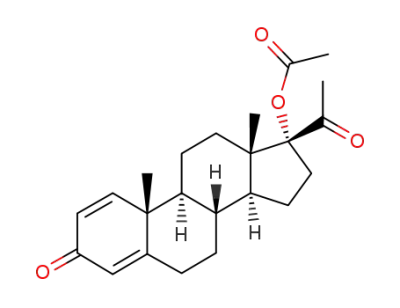
17-acetoxy-pregna-1,4-diene-3,20-dione
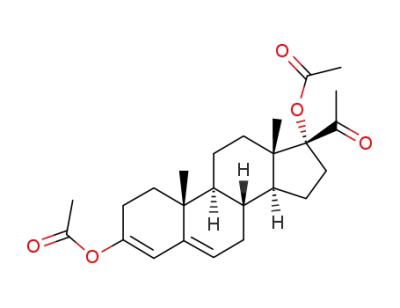
pregna-3,5-dien-20-one, 3,17-dihydroxy-, diacetate
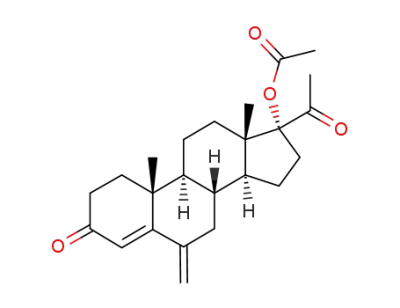
17α-Acetoxy-6-methylene-pregn-4-ene-3,20-dione
Address:RM 03, 24/F, HO KING COMM CTR, 2-16 FAYUEN ST, MONG KOK, HONG KONGE-mail:sales@revochemical.com
Tel:0086-176 0651 7746
